• Please use real names.

    Greetings to all who have registered to OPF and those guests taking a look around. Please use real names. Registrations with fictitious names will not be processed. REAL NAMES ONLY will be processed

    Firstname Lastname

    Register

    We are a courteous and supportive community. No need to hide behind an alia. If you have a genuine need for privacy/secrecy then let me know!
  • Welcome to the new site. Here's a thread about the update where you can post your feedback, ask questions or spot those nasty bugs!

Why is this not sharp?

Rachel Foster

New member
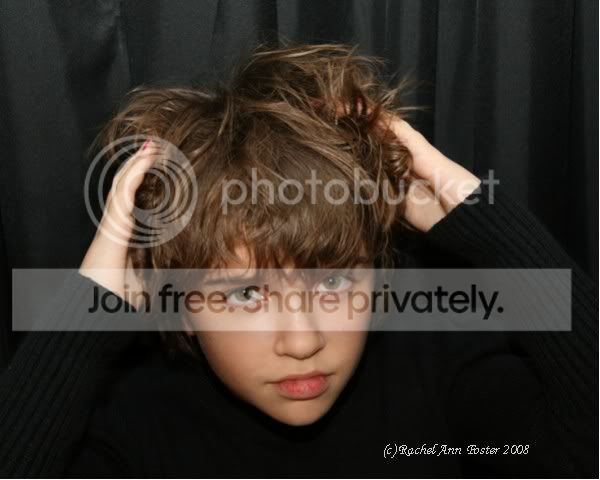
I just shot this on tripod, remote shutter release, auto focus. Am I doing something wrong or is it possibly damage to the Xti when I took that hard fall on the ice last winter? (I plan on sending it in for a tuneup when the 5d II comes in regardless).


Note: all I am enquring about is the focus.

ISO 400, 50mm, f/1.8, 1/400.

161.jpg
 

Cem_Usakligil

Well-known member
Hi Rachel,

Obviously, this is out of focus. It may sound trivial, but did you check the AF/MF switch on the lens? Sometimes it gets set to MF by accident and then you get these kind of results.

Cheers,
 

Nill Toulme

New member
I can't tell if that's front focused or back focused, but if you were using the center focus point, it was approximately on the hairline to the right of the subject's left eye. And at f/1.8 at that working distance, your DOF is pretty darn thin, so the least subject motion between catching focus and releasing the shutter will the eye(s) OOF.

To rule out the camera, take a few tripod shots of a ruler at a 45 degree angle to the camera, and see what you get. Also try a different lens and see if that matters.

And of course what Cem said, as well as taking note of whether you're using one shot, AI focus or AI servo.

Nill
 

Jay Hoss

New member
Rachel,

Have you tried a different lense? Is this the first time using your XTi since it fell? Chances are that the auto focus is out of adjustment
 

Rachel Foster

New member
The fall was last winter, so have used it much since then. Some shots are in focus, some are not. That's what baffles me.

It was AF. I triple checked that.

It sounds like I may need to use a smaller aperture then?
 

Rachel Foster

New member
I *do* get the theoretical of aperture, shutter speed, ISO now, but putting it into practice can still be tricky. I love low-light shooting, so I think I'm asking more of the Rebel than it can do.
 

doug anderson

New member
I just shot this on tripod, remote shutter release, auto focus. Am I doing something wrong or is it possibly damage to the Xti when I took that hard fall on the ice last winter? (I plan on sending it in for a tuneup when the 5d II comes in regardless).


Note: all I am enquring about is the focus.

ISO 400, 50mm, f/1.8, 1/400.

161.jpg

He moved? Isn't that usually what it is? Or you forgot to turn your autofocus on at the base of the lens?
 

Daniel Buck

New member
yea, when shooting fast apertures at relativly close ranges (like portraits) movement of just an inch or two (by the camera, your subject, or both!) can cause your subject to be out of focus. And then you have the problem of what is the auto focus sensor actually focusing on. Usually, when you focus on a portrait, it tends to grab the nose if you place your focusing box at the face, which is just infront of the eyes. The eyes are what you want (or what I usually want). I've had a bit of succes focusing and as soon as the focus would lock, I would lean forward ever so slightly to nail the eyes in focus (while recomposing so that the face isn't centered). After a while you get a feel for it :) It also helps to have a larger viewfinder. Something I really don't like about the low-mid end DSLRs of any make, is the tiny postage stamp viewfinder :-(

And if you know that your lens does not lock accurately when auto focusing, that adds even more complexity to nailing the focus.
 

Rachel Foster

New member
Thanks Daniel. I think the 5dII might help, but not if I"m doing something stupid. I have SOOOOOOOOO much to learn that's always a possibility.
 

Daniel Buck

New member
Thanks Daniel. I think the 5dII might help, but not if I"m doing something stupid. I have SOOOOOOOOO much to learn that's always a possibility.

even with a good camera and a good autofocusing lens, you're not going to nail the focus every time, maybe 1/2 of the time at best :) That's just kind of the nature of the beast with thin DOF
 

Diane Fields

New member
I *do* get the theoretical of aperture, shutter speed, ISO now, but putting it into practice can still be tricky. I love low-light shooting, so I think I'm asking more of the Rebel than it can do.

I don't think so. I've shot with the 5D for almost 3 years and bought a used 400D/XTi late Summer for my 'small' camera. I've been shooting with a 28 f /1.8 and 50 f/1.4 with no problems in low light. I would certainly have the focus checked though. I agree though, that with a very thin DOF you can't always nail the focus--esp. handheld.

Diane
 

Rachel Foster

New member
I am thinking for the kind of shooting I love (low light) that as long as I'm limited with a relatively low ISO I'm going to need the large aperture. The DOF is a problem, I suspect, so I need to be able to shoot with a higher ISO.

At least, I'm hoping that's the problem.
 

Daniel Buck

New member
I am thinking for the kind of shooting I love (low light) that as long as I'm limited with a relatively low ISO I'm going to need the large aperture. The DOF is a problem, I suspect, so I need to be able to shoot with a higher ISO.

At least, I'm hoping that's the problem.

one thing you may want to try, is moving your focusing button to the * button, it's a custom fucntion. Lets you focus (* button) and meter/shoot (main shutter button) independently of each other :) Are you using the center-point focusing? If not, I would suggest you try that.

above all though, more practice, I suspect :) Good luck!
 

Nill Toulme

New member
The full frame camera will be a mixed bag on this. As I understand it, the 5D's AF is not substantially better than the Rebel's (which is pretty darn good). The larger brighter viewfinder will make it easier to see when you have focus and when you don't, BUT — in some respects (it's complicated and sometimes devolves into quasi-religous arguments) your DOF will be even thinner.

Do check out the camera with a controlled test, but practice is really the key.

Nill
 

Diane Fields

New member
The full frame camera will be a mixed bag on this. As I understand it, the 5D's AF is not substantially better than the Rebel's (which is pretty darn good). The larger brighter viewfinder will make it easier to see when you have focus and when you don't, BUT — in some respects (it's complicated and sometimes devolves into quasi-religous arguments) your DOF will be even thinner.

Do check out the camera with a controlled test, but practice is really the key.

Nill

I tend to agree with Nill on this. Since I have the 5D (almost 3 years) and the XTi (only several months) I have had a chance to compare things like this. The XTi's AF is pretty doggone good as he says and the biggest difference IS the viewfinder size altho' I would still put the 5D at the higher percentage of good captures, but I wouldn't count on it being significantly more. With either its so important to make sure you have very good contrast at the point you want to focus and be very well stabilized with a thin DOF (and yes, the DOF will be even thinner--I can't explain it technically either LOL--more or less understand it, but wouldn't want to put what I know in print LOL).

Diane
 

Doug Kerr

Well-known member
Depth of field and format size

Hi, Diane,
. . .(and yes, the DOF will be even thinner--I can't explain it technically either LOL--more or less understand it, but wouldn't want to put what I know in print LOL).

If we compare the depth of field exhibited with two cameras, of differing format size, under the following conditions:

*The focal lengths used produce equal fields of view on the two cameras.
*The acceptable circle of confusion expressed as a fraction of the format size is the same for both cases.
*The aperture (as an f/number) is the same in each case.
*The distance at which the camera is focused is the same in each case.

then the larger format camera will exhibit the smaller depth of field.

The key to this perhaps surprising result is in the first of the "conditions", regarding the focal length. The greater focal length required in the "larger format" case decreases the depth of field for a given acceptable circle of confusion (expressed in absolute terms, in millimeters).

The second condition, in which we accept a larger circle of confusion (in millimeters) for the larger format camera results in an increase in depth of field, but it is not as great as the decrease resulting from the difference in focal length.

Thus overall, the depth of field is greater for the larger format camera.

 

Rachel Foster

New member
I'm thinking with the ability to use a higher ISO, I can close the aperture a bit and open the dof. Am I right on this? By going to, say, an aperture of 7 or so (whatever the precise number is in that range) I'll increase my dof appreciably?
 

Nill Toulme

New member
You don't have to go nearly that far. For that shot, for example, you could have simply halved your shutter speed, to 1/200, and halved your aperture, to f/2.5, or maybe gone to 1/125 and f/2.8, and you probably would have been fine. A fairly (but not overly) narrow DOF is often desirable for portraits. You just have to experiment and find the effect you want for a given situation.

This is why I like aperture priority AE most purposes. You set your aperture where you want it to control your DOF, then adjust your ISO to get adequate shutter speed.

Nill
 

StuartRae

New member
Hi Rachel,

You don't say how far away the subject was, but I'll assume 6 ft. In this case the DOF is 3.47 inches, 1.692 in front of the focal point and 1.78" behind.

Above figures provided by http://www.dofmaster.com/dofjs.html

You obviously don't have 3.5" in focus, so I assume that:

The subject has moved quite a bit;
You haven't focused on the face (eyes preferable); $$
Your camera/lens is faulty.

Regards,

Stuart

$$ Are you using centre point focusing or are you using all the focus points? If the latter then you may have focused on something you didn't mean to. Try setting the camera to use the single centre point and focus on the eyes.
 

David McKinny

New member
Rachel,
I have been playing around with a 50mm 1.8 II lens on my 30D recently. Basically shooting a row of DVD cases in a bookcase from across the room, maybe 15 feet away. This was in a room at night with only a couple of lights on, so it was very low light. Long story short, I found that getting a consistent focus was much harder than I thought at first. Lessons learned...

1) Manually pick one focus point, don't let the camera decide.
2) Make sure you have high enough contrast to get a good lock on the focus.
3) Separate the the focus from the exposure (CF using * button is one way).

At one point I thought I had a bad copy of the lens because I would "always" get OOF shots at f/2.0. At 1.8 is was much sharper, 2.0 blurry, then sharp again all the way through the rest of the apertures. It turned out that for some reason at f/2.0 the focus would not lock on a particular set of DVDs. When I shifted the camera to a different set of DVDs, with more contrast, f/2.0 was just as sharp as everything else.

David
 

Rachel Foster

New member
Thanks, David. I'm waiting til my 5d II arrives and then I'm going to see if it's me using the wrong settings or the Rebel. I fell last winter and the Reb took a hard hit. I suspect it's me, but I want to systematically eliminate other hypotheses.
 
Thanks, David. I'm waiting til my 5d II arrives and then I'm going to see if it's me using the wrong settings or the Rebel. I fell last winter and the Reb took a hard hit. I suspect it's me, but I want to systematically eliminate other hypotheses.

Hi Rachel,

With a megapixel monster like the 5D2 you'll have to adopt different expectations wth respect to per pixel sharpness (IOW at 100% zoom setting). Every little flaw in technique (e.g. camera shake) will be quite visible at the pixel level, but luckily less obvious after downsampling. A tripod (or monopod) is your friend (it's mine as well).

When downsampling your images, which will happen a lot (especially with web publishing) with such large files, you also risk losing important detail, or even create non-existing aliasing artifacts.

We'll get into the details when you have the camera, since it's IMO the better to learn-by-doing. I just wanted to spare you some initial disappointment, don't despair, you'll get it right.

Bart
 

Rachel Foster

New member
Thank you, both!

So, each camera has its own challenges to deal with . That is very good to know. And the essay --- wonderful link! Thanks for that.

As to mastering this, just like photoshop, sharpness WILL be mine someday!
 

Rachel Foster

New member
I've been doing some sleuthing on the sharpness issue. Tonight I shot a series of portraits on P with remote shutter release and tripod (to eliminate my missetting of aperture, shutter speed, camera shake, etc.). The only one that is halfway decent in terms of sharpness is this one.


el30.jpg


And it isn't great. The difference between this and most of the others is my external flash. I'm wondering if how much of my difficulty is due to damage to the camera when I fell and a simple matter of too little light.
 
I'm wondering if how much of my difficulty is due to damage to the camera when I fell and a simple matter of too little light.

Hi Rachel,

Your image looks backfocused, so (depending on how you focused!) the camera+lens may need adjustment.

Try a simple setup, 3 cans of soup, 2 bottles, 3 whatever, placed in a row at a 45 degree angle. Focus on the middle one, and look at the result. Which one is the sharpest? Use a tripod.

You'll have to eliminate variables if you want to get a grip on the issue.

Bart
 
Top