• Please use real names.

    Greetings to all who have registered to OPF and those guests taking a look around. Please use real names. Registrations with fictitious names will not be processed. REAL NAMES ONLY will be processed

    Firstname Lastname

    Register

    We are a courteous and supportive community. No need to hide behind an alia. If you have a genuine need for privacy/secrecy then let me know!
  • Welcome to the new site. Here's a thread about the update where you can post your feedback, ask questions or spot those nasty bugs!

Cultural Imperatives v. Industrial Exploitation: Whaling

Asher Kelman

OPF Owner/Editor-in-Chief
In the U.S.A., having contrary, even apparently hypocritical positions is rather normal. That, however is true of all human societies. We are either self-delusional or deceitful, but then sometimes have very good reasons for making exceptions. It is, after all the exceptions that make things interesting!

At this time, anti-whaling countries are telling Norway, Japan and Greenland that their modern industrial whaling is bad. At the same time the same body is nurturing the indigenous sustainence of the Inupiat Esakimos and other indigenous peoples who have had an intimate relationship with these large creatures for thousands of years.
1.jpg

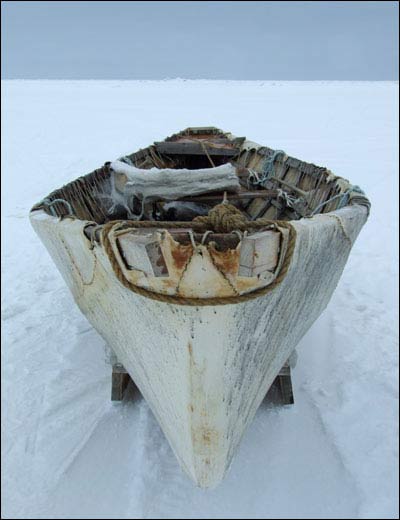
© 2007 BBC Photograph, Photographer not named

"The springtime Inupiat hunt uses the umiaq, a wooden-framed boat covered in sealskin. Boats are towed to the edge of the ice using snowmobiles." "Cultural claim to whale hunting" By Richard Black Environment correspondent, BBC News website, Barrow, Alaska

Richard Black said:
From the Barrow shore, the ice appears to stretch forever.

With feet planted in soft, squelching Arctic mud, you strain to make sense of the jumbled ridges and crags of ice which serrate the white terrain.

At some indeterminably distant point, a band of dark cloud hovers, apparently held between twin fingers of ice and sky.

The cloud marks the end of the shorebound ice, the beginnings of water - the lead which bowhead whales are following as they make their annual northwards trek from the cold waters of the Bering Sea between Siberia and Alaska to the even colder Beaufort Sea.

Strung out along the edge of the lead, waiting for the whales as they have done virtually every spring for 1,000 years, are Native Inupiat hunters for whom whales mark the centrepiece of the nutritional and cultural worlds.

When the whaling captain deems the time is right, his crew will slip their sealskin boat into the water and sidle up to the whale, ignored by their prey which perceives the boat as just another wild creature sharing its ocean.

If the crew's skill and fortune hold out, the prize will be killed with an explosive charge, snared with harpoons and wrested back to the ice, to lose its skin, blubber and meat to the appetites of the Barrow Inupiat community.

Double standards?

The Alaskan Eskimo hunt is one of five permitted by the International Whaling Commission (IWC), which is holding its annual meeting in Anchorage on the other side of Alaska under rules governing "aboriginal" or "subsistence" hunting.

The right is handed out to groups which, in the IWC's view, have a nutritional and cultural need for whalemeat, and where the whale population appears sufficiently robust.

Quotas are awarded for periods of five years. Maintaining the Alaskan bowhead quota is a political imperative for the US, which is why it volunteered to host this year's meeting and hold it as close to the Inupiat communities as possible.

"It's the way of life for the Native Eskimos," says US whaling commissioner Bill Hogarth.

"They use [the whales] for everything, for their whole livelihood, and they share the meat between the villages. We feel it's extremely important for them, and so long as it meets its scientific criteria, this quota should be granted."

That is not to say that everyone is happy with the US policy of supporting subsistence hunting as it currently exists, but blocking and condemning all other whaling.

"The US is an anti-whaling whaling nation - it hunts whales and is against whaling elsewhere," fumes Rune Frovik from the High North Alliance, which campaigns for the rights of whalers and sealers in northern latitudes.

"This is at the outset an irreconcilable and contradictive policy, and has made the US worthy of accusations of double standards and hypocrisy."

Similar sentiments exist in the Japanese camp, which has constantly asked that four of its coastal communities, with whaling traditions dating back hundreds if not thousands of years, also be granted quotas...

Opponents argue that the Japanese coastal communities are basically modern towns. Some are involved in Japan's current scientific whaling programme, where they hunt using modern boats and modern harpoons...

But Greenland's indigenous hunters, unlike the Inupiat, also use modern boats and modern harpoons. They also sell some of the meat. ..............
read more here .

To me, this action is not hypocritical! The eskimos could probably triple their catch and they wouldn't damage the whales viablility. That cannot be said of industrial whaling.

The Norwegian ships under the control of the powerful Greek shipping magnate Onnasis, after WWII, was particularly ruthless in the hunting of whales and their offspring. Todays factory ships are even more powerful to hunt and remove form the oceans these rare creatures at will.

So industrial whaling must, IMHO, be separated from Eskimo subsistance catches!

In this case, I believe the USA and it's anti-whaling supporters are correct and doing the right thing, (at least measured by my own imperfect moral and ethical standards).

The meetings are going on right now!

How does this seem to you?

Asher
 
Last edited:
Jeff Donovan

New member
Japan's "scientific" whaling program is a joke. Even most Japanese don't believe it.

Whale meat was fairly important in Japan after WWII, but most people there nowadays have never even tasted it.

Their program is essentially the government kissing ass to a few key constituencies.
 

Asher Kelman

OPF Owner/Editor-in-Chief
Japan's "scientific" whaling program is a joke. Even most Japanese don't believe it.

Whale meat was fairly important in Japan after WWII, but most people there nowadays have never even tasted it. Their program is essentially the government kissing ass to a few key constituencies.

BBC News today said:
...with pro-whaling nations amassing behind the Greenland bid, a decision was deferred.

The other bids, from the Chukchi of north-eastern Russia, Alaskan Eskimos, the Makah tribe of Washington State in the US, and the Beqians of St Vincent and the Grenadines, involved maintaining existing quotas, and passed without problem.

Talks about talks

The fiercest row currently concerns Japan's plan to add 50 humpback whales to its annual Antarctic hunt, which it conducts in the name of scientific research.
Source is the BBC news today.

The International Whaling commision continues to argue things out. Australia and New Zealand are fiurious that Japan is threatening to unilaterally increase the number of whales caught, eveen though there is no inigenous cultural subsistance need. Easentally like Greenland, there's is commercial whaling.

I hope Greenlands plan is not approved because most of the meat is apaprently sold anyway!

Kudos for the U.S. for hosting the meeting! I hope there is enough restraint to allow the whales to maintain their populations. As it is a majority of fish are threatened by over fishing with wipe out.

Asher
 

Asher Kelman

OPF Owner/Editor-in-Chief
The update today is a disgracefull vote of greed arrogance by the whaling nations as South America sought to have an Antarctic whale preserve with international protection.

"Proposals for a South Atlantic whale sanctuary have been defeated in the first vote at the International Whaling Commission's meeting this year.

Proposed by Latin American countries, it would have seen whale protection extended northwards from the existing Southern Ocean sanctuary.

Meanwhile, Denmark has moderated a controversial plan to boost subsistence whaling by Greenland Inuits."
Source .

The hypocracy is that Greenland want protection for it's claimed indigenous coastal whaling needs, but they have no empathy for the needs of South America to protect their own coastlines form industrial predation! Australia and New Zealand are in a panic too as they just have to wait and see what effects stock depletion has on the whales that they cherish to look at as part of nature's wonders and an key pillar of their tourist industries

"Latin American countries have repeatedly tried to establish a sanctuary in the south Atlantic, and professed themselves disappointed at the vote.

Delegations supported the proposal by a margin of 39 to 29, which fell short of the three-quarters majority needed. Japan voted against, as did Norway, Denmark and many Caribbean and African countries.

"We are very sad because we are trying to emphasise (the needs of) many coastal communities in Brazil, in Uruguay, Argentina, even South Africa, but they are not respected here with this decision," Argentina's whaling commissioner Eduardo Iglesias told BBC News.

"The position of Japan is particularly inconsistent - it asks why its small coastal communities cannot have some kind of whaling, and when we ask for some protection for whales in our areas, they don't respect that."!"


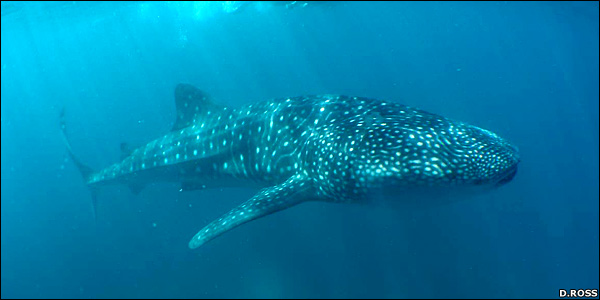
In a related development, the Australians and New Zealanders are now asking whether the Whale Sharks, not true whales, but the largest of fishes, are threatened too?

1.jpg


Now, the whole world of whales is a little more complex than the tale of "Moby Dick".

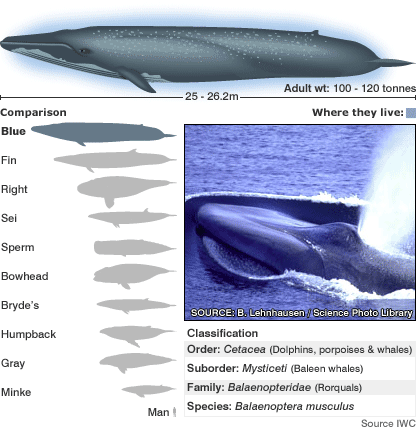
These stunning creatures cover a variety of species, sizes and dependence on different food chains.

1180107374.gif


The source of this image and a guide to the great whales is found here

Now is it not reasonable to have sanctuaries for these vulnerable mammals as the South American maritime nations are demanding?

My view is that hunting should only be allowed to the extent that the whales are overpopulated and are destroying their own ecosystems!

Asher
 
I was fortunate to swim and dive with these gentle giants in the south ari atoll on the maldives. Whale Sharks are amongst the most amazing creatures I have ever encountered.

http://www.whalesharkproject.org/prospectus.asp?siteid=6

A lot has to be learned about this amazing species and many behaviours still remain a mystery.

If you image that people sitting in an office pushing paper day in day out, people who never were in direct contact with whales, who have absolutely no understanding about their importance and their beauty, that those people make policies and support the Greed of some whackjobs who are out to make a buck, it is sickening to the bone.

The encounter I had with 2 whale sharks left a lifelong impression on me. When I came back to the island, I showed my film to the people on the island, and there was a great exitement. You know, it was strange, an island that you can walk around in less than 20 minutes, but the division of natives and tourists was well taken care for. The few natives of course living away from the climatized luxury huts of the rich tourists. Their purpose on the island was to clean, cook and serve the tourists.

On my second day I went to their place and while they were a little embarassed and shy, they were most welcoming and friendly, only irritated that one of them is interested in their life. Normally tourists did not bother to talk to them other than to order more beer or complain about too spicy meals. <grins> For recreational and other purposes they chew a nut that contains psychoactive alcaloids. When they knew me better they offered me slices of it which I took. A very mild stimulative which increases over time of usage, interesting and pleasant, however, not recommendable for a permanent consumption of course, it is addictive.

When I showed them the film of the whale shark and her baby, their reaction was so profoundly impressive, I will never forget that. They were all talking very loud and over each other, of course I did not undertsand a single word, but the feeling of joy and pleasure was obvious. Some of the elderly people were in tears, tears of joy in deed, and although the whole footage was only 6 minutes, it became a feature length film as they demanded over and over again to see it for the next 2 hours. <smiles>

From this day on my time there changed, as I was no longer a tourist in their eyes. I had booked a holiday for 4 weeks, and it became a life changing experience. I went back to the Maldives 2 month later and stayed for over 6 month.

According the UNO they were amongst the poorest people on the planet, I have not seen poor people there at all, only beautiful human beings, and rich, very rich in deed, but rich in ways that some of those paper pushers never will understand.
 

Asher Kelman

OPF Owner/Editor-in-Chief
Thanks so much Bear for the great experience you have enjoyed with the real people on the Islands and sharing the special stories of your visits there.

Swimming amongs the whale sharks must be an immensely poweful experience, since one is so close to such beauty, hone for millions of years!

The link you give to whale sharks is very informative and the pictures are rewarding to vist.

Yes, we need to know about these creatures. That is why I like pictures of nature!

Maybe you might share your images here!

Asher
 
Sadly, none of the films or pictures exist anymore. "Storms of life" washed them away.

Yes, this was certainly the most impressive encounter I ever experienced. I dived in a swarm of thousands of barracudas, was "trapped" in a schole of hundreds of hammerhead sharks, stumbled bare feed in a nest of copperhead snakes, snorkled with dolphins in freezing water in November in Ireland, chased blackbears out of my camp, but the whale sharks this was something that I can not express in simple words.

I was speechless for 30 minutes after I came out of the water. I just sat on the beach in total trance, not even checking the film material, I did not care. The only way I can describe it is that it filled me with total happiness on a scale I did not even know exists, deeply humbling, your brain wants to explode but is empty at the same time, a feeling of deep content, I just sat there grinning like an idiot or like someone who has won the lotto. I truly felt this being is communicating with me, just that I am too dumb to understand!

These events are deeply engraved in me for the rest of my life.

I truly wish everyone could experience this, it has changed my life profoundly, and I have no doubts, it would make a lasting impression on most people in deed.

Btw. it is not entirely know how old they can become, but chances are that these 30 tonnes giants can reach an age of 180 years. Heck, we can build starwars, for that there is always money there, but our own blue planet, we know so very little about, and have it destroyed even before we discovered it, such as the rainforests, the most valuable treasurechest for medicine on the planet, chained for mahagonny kitchens.

I mean come on, imagine that a shark that would have reached that age and died today, he would have been born in the year where L.v. Beethoven died, the english/russian/french fleet beat the turks in the battle of Navarino, an english chap invents wooden matches, New York State abolishes slavery, in 1827.

Sigh, I need a burgundy now.

Cheers <smile>

P.S.
The longer I think about my sea- landscape photography, the more I think I have the responsibility to link this with awareness for the fragility of such beauty and our responisbility to protect it for our children.

P.P.S.
We are celebrating the birth of the first free born golden eagle chick here in Ireland, since over 100 years that is. A project that started in 2000 and now starts to show results, now here is a reason for hope! <smiles>
 
Last edited:
Top