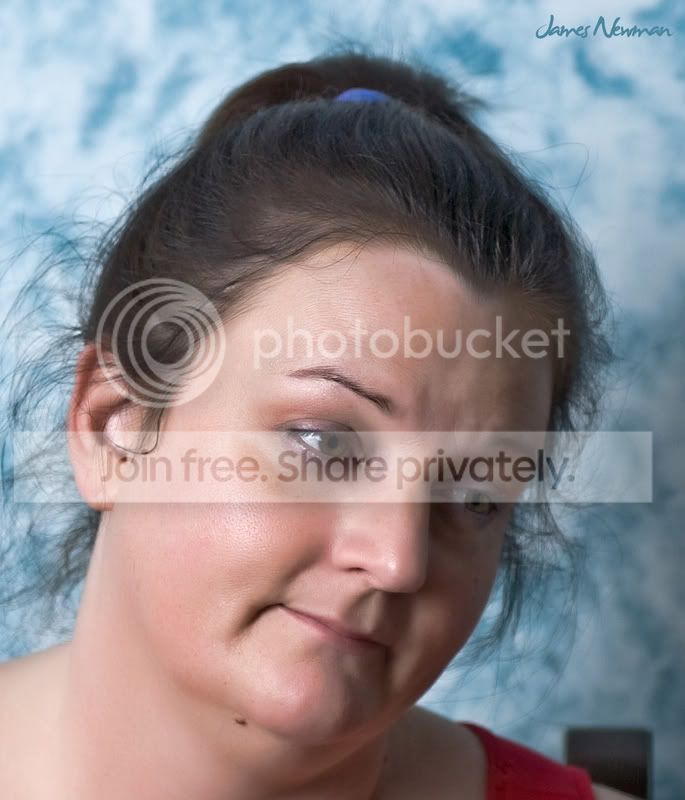
Bad poses, bad hair, needing a shave, etc., all that aside, what do you see being needed in the lighting setup? Some others I showed all agree that I needed to boost the fill up a bit.
Hi James,
I think that if you reduce the background brightness a little, you'll find the fill to be adequate. You could either shade some of the main light falling on the background, or increase distance.
To train your sense for lighting, it usually helps to first practice with 1 light, positioned at various angles (keeping a constant height) from behind to the front and to the back again on the other side, at a constant distance to the subject. The constant distance will avoid brighness differences, and relatively larger lightsources produce softer shadows. That will show you how the light starts lighting/shading the nose/cheek/chin/forehead/eye(socket)s. You also can use some of those positions, and vary the height. Once you get that feeling for what happens to the human features, you can tone down the contrast by adding fill light. Try the effects of the fill light when it comes from the camera position (which retains the effect of the main light), or from another angle (which will create new shadows by itself). You'll find that there are common main/fill ratios that work in most cases.
I usually advise others to learn a classical setup, which projects the shadow of the nose tip to the corner of the mouth, and then deviate if it improves the facial features. It is usually more flattering to light from the side of the face that's turned away from the camera (to avoid the ' mumps' look). Frontal fill light (slightly above the camera) is a good starting position.
Next will be the positioning of the model's face (or conceptually the camera angle) and the pose, which is a completely different, although related, exercise.
Bart