
Doug Kerr
Well-known member
Of course, Independence Day is celebrated in the US on July 4, and in fact the holiday is often spoken of as "The fourth of July."
Each year on Independence Day, the City of Alamogordo presents a fireworks display, the site being that of the New Mexico Space History Museum, which occupies the highest spot in the city itself (about 150 feet higher in elevation than our home).
Usually, we watch the display from two folding chairs on the sidewalk halfway to the neighbor's house, from which we have an almost unobstructed view of the display through the gap between the two houses across the street.
But this year, just as the display started, it began to rain - not a heavy rain, but a definite sprinkle. (This is in fact monsoon season here in Southern New Mexico, during which we will get the major part of the perhaps 11 inches of rain we get all year!) So we retreated to the mouth of our garage, from which vantage point only the lower parts of the display were blocked by the roof of the house directly across the street.
The "choreography" of the display is not to my liking. I prefer to see a major piece shot and let play out, so we can see the effect the designers have worked so hard to produce. Perhaps it throws a ring of little stars, or a pattern of little blue lights, or a ring of little fires, each of which shoots a little ring of little stars.
But lately, just as in the case of the hundreds of times more expensive displays we see on TV from Washington, New York, and Boston, here the pieces are fired seriously overlapping, so that there are typically three or more playing out in the field of view at one time, there generally being no sense of complementation.
Sometimes, the result may be effective, when the pieces are complementary. But most of the time it is just an aerial pyrotechnic mish-mash.
All that having been said, here are a couple of shots I thought were pretty:
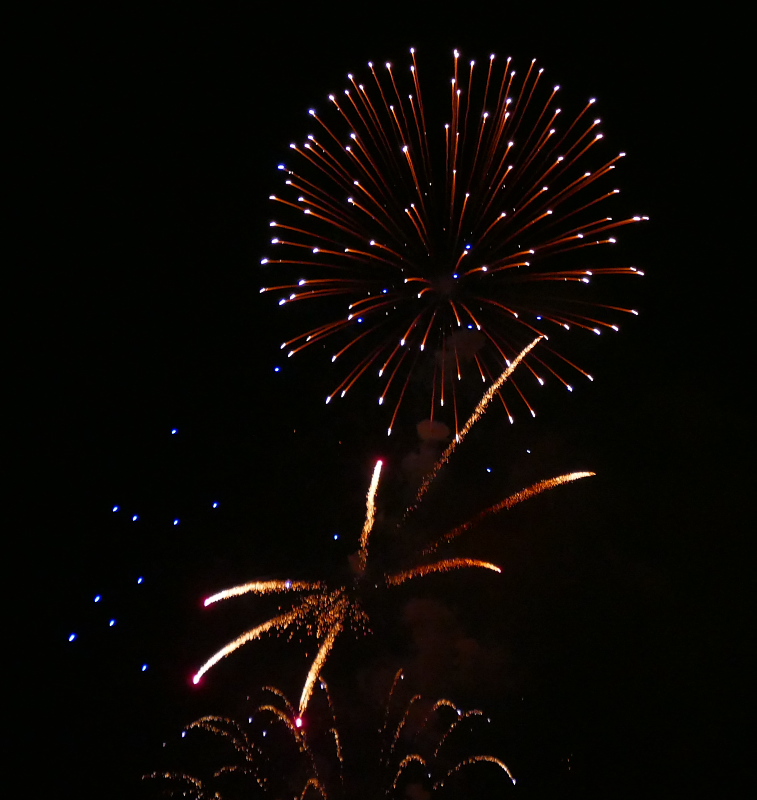
Douglas A. Kerr: The glorious Fourth
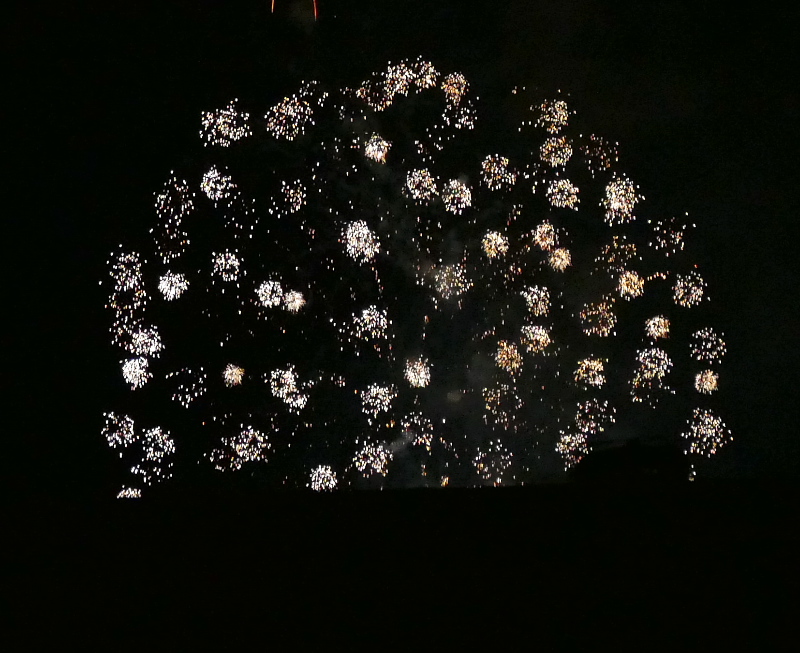
Douglas A. Kerr: Nonpareils en le ciel
Here we see a "combo" that worked out nicely. Was this just an accident?
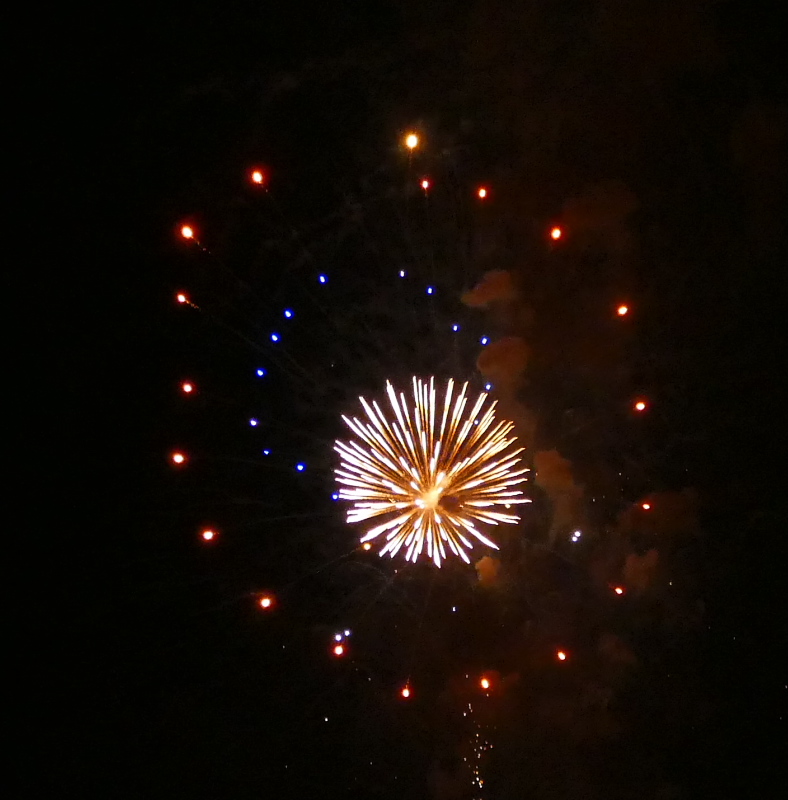
Douglas A. Kerr: En montage
And another, this being reminiscent of the work done by some nifty post-processing programs:
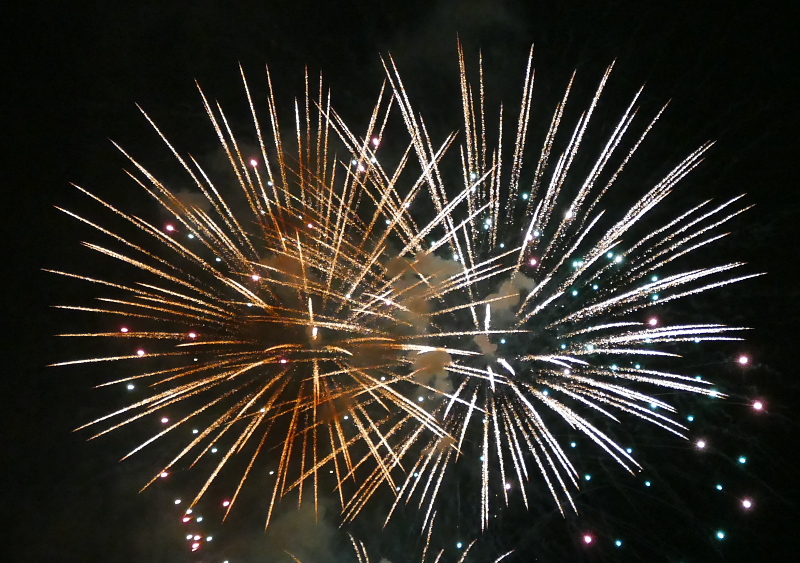
Douglas A. Kerr: Him and her
Finally, on a different front, this shot was taken inadvertently out-of focus, but I'll take advantage of it to illustrate the bokeh performance of the Zeiss Vario-Elmarit 9.1-14.6 mm f/2.8-4.0 lens on my trusty Panasonic DMC-FZ1000:
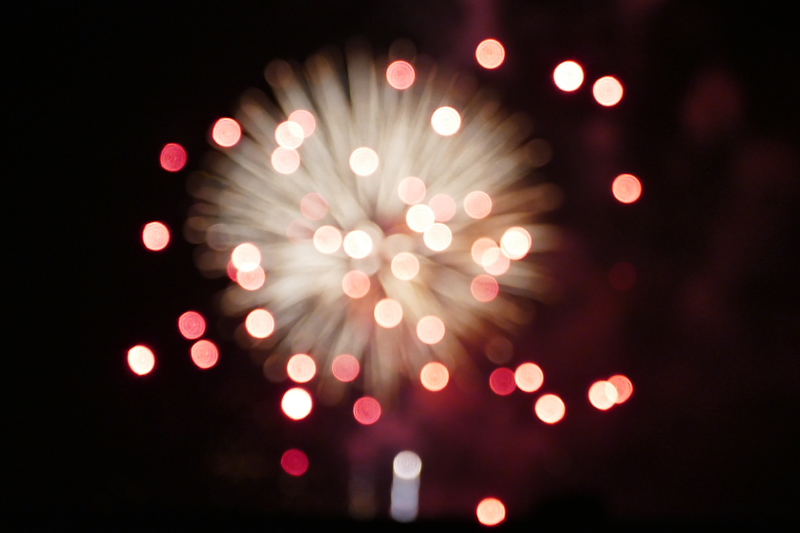
Douglas A. Kerr: Bokeh-dokey
This was taken at f/4.0, the lens wide-open at this focal length.
We see that the blur figures are nicely circular in outline (might be not so much at a slightly smaller aperture; at this aperture the iris has probably retreated from the battle zone altogether), and have a generally-uniform illuminance across the disk (some like that, some not). But we see a fairly prominent "crust" at the rim, generally considered undesirable. (Some of that may be from longitudinal chromatic aberration.)
Best regards,
Doug
Each year on Independence Day, the City of Alamogordo presents a fireworks display, the site being that of the New Mexico Space History Museum, which occupies the highest spot in the city itself (about 150 feet higher in elevation than our home).
Usually, we watch the display from two folding chairs on the sidewalk halfway to the neighbor's house, from which we have an almost unobstructed view of the display through the gap between the two houses across the street.
But this year, just as the display started, it began to rain - not a heavy rain, but a definite sprinkle. (This is in fact monsoon season here in Southern New Mexico, during which we will get the major part of the perhaps 11 inches of rain we get all year!) So we retreated to the mouth of our garage, from which vantage point only the lower parts of the display were blocked by the roof of the house directly across the street.
The "choreography" of the display is not to my liking. I prefer to see a major piece shot and let play out, so we can see the effect the designers have worked so hard to produce. Perhaps it throws a ring of little stars, or a pattern of little blue lights, or a ring of little fires, each of which shoots a little ring of little stars.
But lately, just as in the case of the hundreds of times more expensive displays we see on TV from Washington, New York, and Boston, here the pieces are fired seriously overlapping, so that there are typically three or more playing out in the field of view at one time, there generally being no sense of complementation.
Sometimes, the result may be effective, when the pieces are complementary. But most of the time it is just an aerial pyrotechnic mish-mash.
All that having been said, here are a couple of shots I thought were pretty:
Douglas A. Kerr: The glorious Fourth
Douglas A. Kerr: Nonpareils en le ciel
Here we see a "combo" that worked out nicely. Was this just an accident?
Douglas A. Kerr: En montage
And another, this being reminiscent of the work done by some nifty post-processing programs:
Douglas A. Kerr: Him and her
Finally, on a different front, this shot was taken inadvertently out-of focus, but I'll take advantage of it to illustrate the bokeh performance of the Zeiss Vario-Elmarit 9.1-14.6 mm f/2.8-4.0 lens on my trusty Panasonic DMC-FZ1000:
Douglas A. Kerr: Bokeh-dokey
This was taken at f/4.0, the lens wide-open at this focal length.
We see that the blur figures are nicely circular in outline (might be not so much at a slightly smaller aperture; at this aperture the iris has probably retreated from the battle zone altogether), and have a generally-uniform illuminance across the disk (some like that, some not). But we see a fairly prominent "crust" at the rim, generally considered undesirable. (Some of that may be from longitudinal chromatic aberration.)
Best regards,
Doug