• Please use real names.

    Greetings to all who have registered to OPF and those guests taking a look around. Please use real names. Registrations with fictitious names will not be processed. REAL NAMES ONLY will be processed

    Firstname Lastname

    Register

    We are a courteous and supportive community. No need to hide behind an alia. If you have a genuine need for privacy/secrecy then let me know!
  • Welcome to the new site. Here's a thread about the update where you can post your feedback, ask questions or spot those nasty bugs!

Tourist's Golden State Bridge

Eugene Ye

New member
Tourist's Golden Gate Bridge
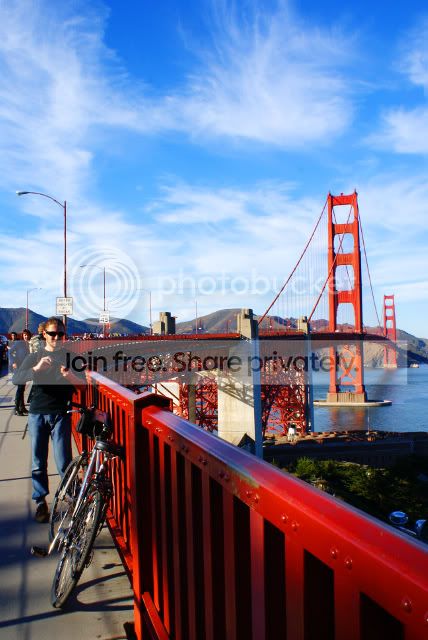
Golden_State_Bridge_Flow.jpg

Hi All. Took this when I was at SF last year. It is meant as a travel photo so it is captured and edited on jpeg.

I like the flow of the bridge in this photo, the cloud formation, and the human and bicycle on the foreground at the turning point (is this placing good or bad or doesn't matter?) of the bridge towards viewer.

I think the amount availability of humans show it is a tourist attraction, and the device that the black shirt guy looks to hold makes viewer assume it to be a camera and thus reinforce the tourist attraction idea. The bicycle shows that it is an (popular) activity to cycle past the bridge.

not sure if I am correct with my interpretation of this photo, but it is good if any of you can tell me where I went wrong in my interpretation to help me learn.

I feel that I might like it better to shoot a little lower and thus shows more of the foreground bridge at the right photo edge, but this would reduce some of the cloud. i also feel that tower (or whatever it should call) is slanting and looks very bad to me. Yes, I do notice that the photo seems to cut in halves rather than at a-third. Is this really bad for this photo?

Look forward to opf members guidance. thanks.
 
Last edited:

Ken Tanaka

pro member
...
I like the flow of the bridge in this photo, the cloud formation, and the human and bicycle on the foreground at the turning point (is this placing good or bad or doesn't matter?) of the bridge towards viewer.
...

Eugene,
That paragraph neatly sums the primary problem with this image, in my opinion. You haven't made any decisions, and have tried to cram all of this into a single, standing perspective. It doesn't work.

Generally speaking, clouds in scenes like this are only useful to the extent that they can present contrast or geometric emphasis to a main subject. Here they're puffy little distractions that occupy nearly half of your frame! I'll bet you have clouds in your home skies, eh? ;-)

You've also missed the opportunity to let the beautiful curved red approach railing lead our eyes to the actual bridge by (a) crowding the line too much (shooting vertically trying to get those silly clouds in the frame), and (b) putting clutter on the rail in the very cramped frame-left foreground. Again, by trying to get those clouds in the same frame you've also lopped-off the bridge's terminus, a small item that creates an unsettled feeling to the whole scene.

Your color and contrast are also over-cranked. Too much blue, way too much saturation, way too much contrast/too low a black point.

Painting is an inclusive art form. That is, the artist must decide what to put onto the canvas. Photography, by contrast, is an exclusive undertaking. The snapper must fundamentally decide what to exclude from the frame. The next time you're faced with a potentially complex scene like this STOP! Consider what's really going to be important. Look at that viewfinder image as though it's the final photo. By taking time to make exclusion decisions for each frame, and often repositioning the camera as a result, you'll generally get better images.

In the case of this particular scene you have to think to yourself that the world doesn't need another Golden Gate Bridge photo. There are already about 200 billion, mostly the same ol' same ol', many available on postcards and souvenir books. So ask yourself why you're taking a photo at all. That will help you to arrive at such a "decision".
 

Asher Kelman

OPF Owner/Editor-in-Chief
In the case of this particular scene you have to think to yourself that the world doesn't need another Golden Gate Bridge photo. There are already about 200 billion, mostly the same ol' same ol', many available on postcards and souvenir books. So ask yourself why you're taking a photo at all. That will help you to arrive at such a "decision".

Eugene,

This s a common problem for tourists, the best one gets is a pretty postcard and that's fine for mementos especially when someone close to you is in the picture. Here's my approach when there's time. Turn off you camera for a while and just look. Even bring with you a small note book with no lines and sketch the components you want. Don't worry that you might not be able to draw well as the camera does that for you. Instead mark shapes and lines very quickly with squares, columns, triangles, lines and circles to extract what's important. Is that optimum? Could moving to the right or left or up or down give the better composition. Is something n the way? You might plan to remove that in Photoshop so take extra pictures. If you have a tripod and a Neutral Density filter, you can take a long exposure and the people will disappear if there were not a solid crowd there.

Now look at the lighting? Is this the best time to take the picture. Snap one and come back at sunset perhaps or when the sun is out according to your design. This way, you will likely have a picture of the famous landmark that has your distinct mark.

Asher
 

Eugene Ye

New member
Thanks Ken and Asher,

It now really looks to me that I am still unable to grasp what should be in a photo and what not. My interpretation was all wrong. Thanks a lot for the detail and careful description. it helps me alot. Those that I thought was useful elements have actually turned out to be bad. I am really learning here.
cheers
 

Asher Kelman

OPF Owner/Editor-in-Chief
Purpose in photography v. snap, snap, snap!

Thanks Ken and Asher,

It now really looks to me that I am still unable to grasp what should be in a photo and what not. My interpretation was all wrong. Thanks a lot for the detail and careful description. it helps me alot. Those that I thought was useful elements have actually turned out to be bad. I am really learning here.
cheers

Eugene,

It's not hard to take pictures for a purpose.

For memento's most of us do well. We know that it's great to have our dear ones in the picture. For other matters, there are examples around. Weddings have albums but fools rush in when they do favors. It's best to study with a pro first. The same applies to most vertical markets in photography.

For breaking news, your snap, however artless could make you a fortune. A Ruby shooting an Oswald will make your name. A pictures of a wooly mammoth with her infant that wake up from the permafrost will be historic! All your pictures will be perfect, so don't worry about your composition, LOL!

Art is another matter. There's galleries, books and magazines with great art. So that's the world you will be moving toward. Because no one is relying on your results for their commerce or life's memories, it's perfectly fine for one to make lots lots of mistakes on the job!! With digital photography, the only cost is time. That's what it seems. However merely snapping around does not make art unless one might be a resurrected Picasso with a library of forms and motifs ready to guide him.

So that's why one needs to stop and contemplate. Here's some 7 easy rules that I'd offer could help in your journey:

1. Enjoy life and value people, plants animals and what they each achieve. Shake hands, listen to folk and treasure their children. Don't pass a beggar without thinking. Don't pass flowers or trees without greeting them. Passion needs to be nurtured.

2. Visit art museums and galleries and buy one book, perhaps, on what you like best and will miss the most. Passion has to be nurtured.

3. Find out what are your own values, preferences, hopes, fancies and what you admire. You need to link passion to intent! If you have no intent, then there's no purpose and no point to photography!

4. Take a drawing class, simple still life. Get to see how light works and how one thing seems to balance and argue with another. We need education on how to arrange possibilities. Art is about that.

5. Have a project to photograph XYZ. Stalk the subject, like a lion hunting its prey.

6. Sketch and snap

7. Evaluate and go back to 5 and keep at it! Eventually you wont need to sketch, you'll do that automatically. When you come home, you'll have something close to your heart that you intended to make that has your fingerprints on it. When you are thrilled, art has opened it's eyes, there's life!

You probably know most of these points, but perhaps there's something here to help you.

Asher
 

Ken Tanaka

pro member
Thanks Ken and Asher,

It now really looks to me that I am still unable to grasp what should be in a photo and what not. My interpretation was all wrong. Thanks a lot for the detail and careful description. it helps me alot. Those that I thought was useful elements have actually turned out to be bad. I am really learning here.
cheers

Go easy on yourself, Eugene. Travel photography is much harder than it might seem. You're usually in unfamiliar surroundings for a limited time (i.e. you have to shoot where you are, when you're there), and your whole sensory system is often being overloaded with new stimuli even in quiet moments. In such situations most of us will point the camera like a rifle and fire at whatever's in range. I'm certain that if I visited your home town for a few days I'd snap some real howlers!

Practicing photography nearly every day is important, even if it's just a frame or two. More important, however, is doing what you've done; showing your images to others and asking their reactions. You may ultimately filter-out 90% of their feedback, for various reasons. But nothing is so important for self-development than early, meaningful exposure and self-evaluation.
 

Ruben Alfu

New member
In the case of this particular scene you have to think to yourself that the world doesn't need another Golden Gate Bridge photo.

Pure truth. One simple technique to add some (relative) originality to photos of landmarks is to describe the whole by one of its parts.
This is a rather extreme example of what I mean, but it serves to illustrate the idea:


golden_gate_crop.jpg


Eugene Ye : Golden Gate Bridge
Recomposition by Ruben Alfu


Ken Tanaka

pro member
Bingo. Thank you for a perfect example of one compositional decision, Ruben. I can almost guarantee that it's unique among that 200 billion other snaps of the Bridge, yet it has enough information to convey an unmistakable location on the planet AND a general feeling about that location on that day.

Just this evening I was looking at a Blurb book by a photographer named Mike Hipple. (He's trying to use proceeds from the book to defend himself against a patently unjust copyright violation suit...but that's another matter.) The cover image of the book, titled "Dailes", presents yet another alternative perhaps from nearly the same vantage point.
 

Eugene Ye

New member
Thanks Asher, Ken, Ruben.

Those steps, encouragements and ideas do help me alot. i have been more patient over the last two days while visiting another town - but it is a popular tourist attraction so i have been there for quite a few times before time. So the advices here do really help.

Thanks.
 
Top