
• Please use real names.

    Greetings to all who have registered to OPF and those guests taking a look around. Please use real names. Registrations with fictitious names will not be processed. REAL NAMES ONLY will be processed

    Firstname Lastname

    Register

    We are a courteous and supportive community. No need to hide behind an alia. If you have a genuine need for privacy/secrecy then let me know!
  • Welcome to the new site. Here's a thread about the update where you can post your feedback, ask questions or spot those nasty bugs!

Down

Last year I had a bout of taking pictures looking down from a height. These are my favorite 3.

The picture below was taken from the very front of the Eiffiel Tour elevator; looking straigt down the elevator shaft. It reminds me of our visit, but may not mean anything to anyone else.


4500785469_01a0b0cfd9_b.jpg


Katherine Porter: "Down"


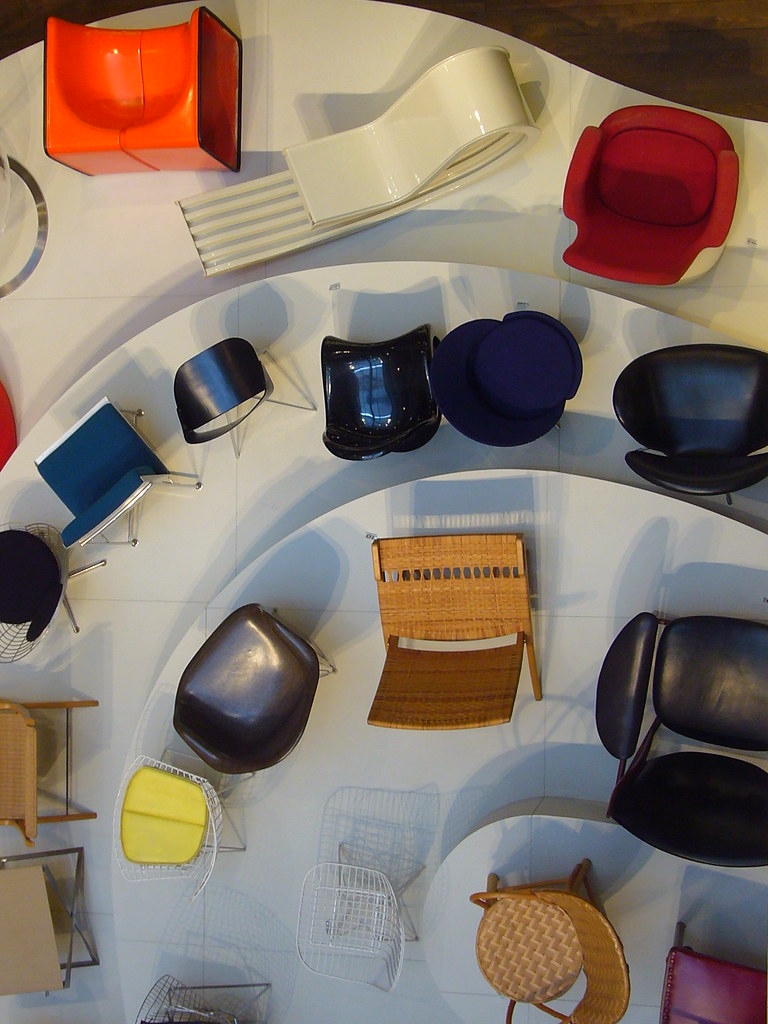
The next one was taken at the Arts Decoritif. There was a display of chairs from various decades on a round 3-tiered platform.


4500785471_4c1c089c62_b.jpg


Katherine Porter: "Chairs - Arts Decoritif"


And lastly, the picture below was taken from the Effiel Tower looking down at the crowd waiting in line. I was drawn by the colors and the shape of the line. I think the picture would have been better if I'd walked to the end of the opening and then taken the picture, but maybe not....


[
4500785479_1bed980ac5_b.jpg


Katherine Porter: "Line waiting to go up the Effiel Tour"


I still like the down concept so any suggestions or comments would be appreciated!

Thanks,
Katherine
 
Last edited by a moderator:

Ken Tanaka

pro member
Hello Katherine;
I'm not seeing any images in your post...but it's almost more fun to imagine their appearance from your captions!

I am a very enthusiastic proponent of conceptual theme photo projects. I find relatively few (amateur snapper) men who are interested in pursuing projects, generally to the detriment of their work which often appears (is) purely impulsive and opportunistic. But, conversely, many women find such projects intriguing...and frequently to the great benefit of their work, which often seems far more maturely thoughtful, more incisive, less impulsive, and less gear-driven.

So that's my general stance on almost any type of photo project.

I'm eager to see your early "Down" work as soon as you manage to resolve the linking issues. Meanwhile, may I suggest that you consider taking the concept to a less literal, more abstractive and conceptual plane? That is, rather than simply pointing the lens down why not consider other implications of "down"?

Addendum
I can now see your images, thanks to Asher's intervention. You're heading in a nice direction for a project collection. For this type of work you'll need to develop your sense of composition to a higher degree. Study basic figure/ground concepts. Harold Mante's "Photographic Composition" is perhaps the best, most timeless, book ever produced on the subject. He deals with enduring principles of perception, rather than the usual cliche, trite concepts paraded in most photo "composition" books by popular hacks.
 
Last edited:

Asher Kelman

OPF Owner/Editor-in-Chief
4500785479_1bed980ac5_b.jpg


Katherine Porter: "Line waiting to go up the Effiel Tour"


Katherine,

I like this picture for the fact that it contains so many opportunities for further creativity. Fragments of the lower left have elongated shadows and a lone figure moving. This is a rich picture to study and explore. It's yours of course and you should investigate what you have. It might not be at all related to "Down" but could even send you off in another direction.

As Ken points out, physical down is one thing and then "Down" might be exploded to drive fragments of ideas to new corners that might prove even more fascinating that the straightforward meaning.

So I see some work on discovering what indeed you have photographed. Does it even need to be related to the obvious meanings of "Down"? Part of an artists fortune, I believe, is having to struggle with one's offspring! What you imagine is going to happen to a piece of clay is not identical always to what pleases you. Same with all things created. You see, no child grows up anything like the parents imagined or the infant promised! The same with art, and one has to accommodate what you have engraved in your image from so very high up. You couldn't have possibly recognized, never mind comprehended, the detail and significance to you, of what you might have gathered. You should allow yourself to be open to being impressed by the various forms you now see in your picture. There are directions of people, shadows, some of the tower and others from elsewhere, but each is writing some message that might or might not resonate with you.

Last year and Paris, might be a long way from you now! Nevertheless, if parts of the details of this view from high on the Eiffel Tower do indeed interest you, then, perhaps, when you look "Down", (from other tall structures),these aspects will be more important in how you frame and compose your image. I don't know where you are located, but if you are in Paris then further work just on this picture will be rewarding. Still, wherever you might be, the lessons from this one picture might help you plan how you might choose to look and what forms you might seek out. You can then use this in any great city.

Ken's reference on composition is likely to be a winner. He is well-read and gives good advice and with panache!

Asher
 

Ken Tanaka

pro member
As a matter of comparison, in 1929 the great photographer André Kertész captured this extremely reknowned image from nearly the exact same vantage point on the Eiffel Tower, perhaps a bit to the left, and with a large-format camera:

eiffel_tower_paris.jpg

"Shadows of the Eiffel Tower", André Kertész, 1929

It's almost impossible to take a bad snap from that vantage point. The most prominent feature of your image is the ticket line; it represents THE statement of the image. In contrast, Kertész's image emphasizes the geometry of the the vantage point, using shadows and dynamic framing to guide your eye. Note also that this is a scene where color is a distracting detriment; the story of the scene is all about the arrangement of tones and lines.

I thought you'd find it interesting to compare your image with an 81-year-old classic.

Addendum
As yet another famous example (and one that took me a few moments to locate online...I should have looked at the National Gallery first!), in 1928 Laszlo Maholy-Nagy captured this even more famous image from a radio tower in Berlin:

fig_3.jpg

"Radio Tower Berlin", László Moholy-Nagy, 1928

Can you imagine doing this with a big view camera...in the wind?!! (His granddaughter recounted a harrowing tale of this image several years ago at an event she attended here in Chicago a while back.)

That these types of images became popular and well-shown in the inter-war years of Modernism was not coincidental. But that's another story, probably for another audience. ;-)
 
Thank you! Asher, I hadn't even noticed the elongated shadows and you're right that could send me a totatlly different direction. Ken, thanks for the book title and for the pictures I love both of them and the very atmospheric feeling of the B&W.
 
For this type of work you'll need to develop your sense of composition to a higher degree. Study basic figure/ground concepts. Harold Mante's "Photographic Composition" is perhaps the best, most timeless, book ever produced on the subject. He deals with enduring principles of perception, rather than the usual cliche, trite concepts paraded in most photo "composition" books by popular hacks.

Hi Ken, thanks for that pointer, much appreciated.

I can say, having ordered the book and after skimming through it and reading a few pages, WOW this is going to be an enjoyable book to read (several times, it covers a lot of things) and browse for the excellent photo's used as examples. This looks like a quality reference from (hard) cover to cover, a definite must read for those serious about the subject.

A small quote from Harald Mante's introduction in the book which resonates well with how I see the subject:
Harald Mante said:
Having learned the elements and principles of constructing a picture and its color design, one has the background also to make qualitative judgements about and criticisms of images. A picture's design elements and color contrasts can be identified and explained analytically and used to evaluate the quality of the composition. There is, then, for the field of two-dimensional composition something approximating an "operating instruction". Knowing the grammar of art equips one to evaluate the qualities of an image, or to produce an image of high quality. Beyond that, it is a deeply enriching experience for educated viewers to see and feel more than before and to see with more skill than other viewers who lack the same knowledge. Applying these artistic methods may not be an end in itself. Knowledge of the rules - actually guidelines - of pictorial design should be totally internalized and influence practical work subconsciously, "from the belly", so to speak. With photographic work the practitioner can concentrate completely on the viewfinder image, the exposure, the subject, and its content.

Cheers,
Bart
 
Top