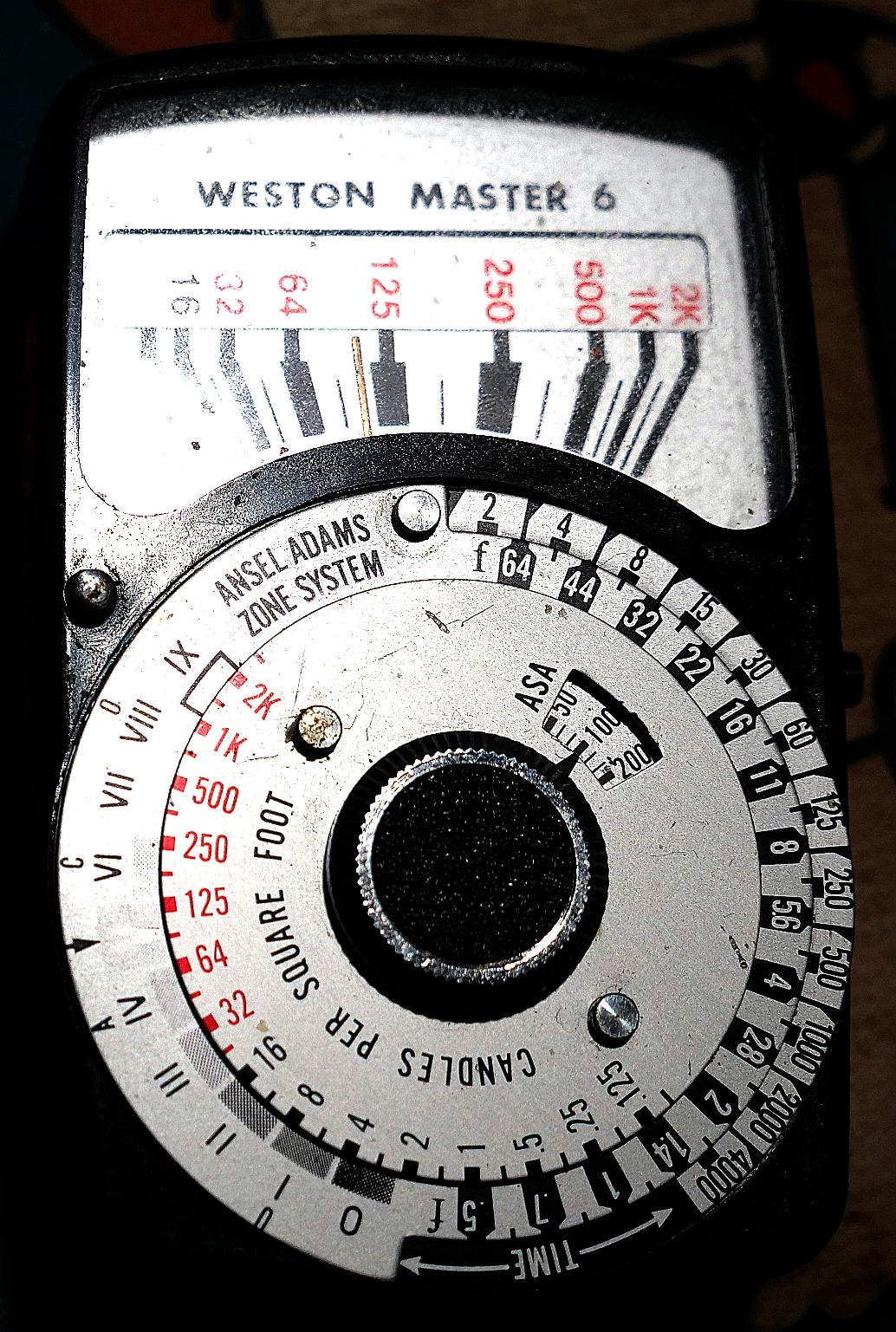
It is interesting to consider some of the phtometric units we encounter in the area of phtographic esposure metering.. The matter is complicated by similar-sounding but different terms, what seem to be compound unit names but are not, and of course various careless practices.
I will disucss here some of these units often encountered in connection with exposure metering.
We might expect that, in the evolution of these chains of terms, we would start with the measure of luminous flux. But in reality, the chains of definitions begin with the meaure of luminous intensity - the "potency" of the emission of light from a small source (ikeally, a "poiont source) in some direction of interest.
Long before the advent of the SI, this was done in terms of the luminous intensity (in a certain defined direction) of a "standard candle", an actual candle in which a precisely-defined type of wax was burned at a specified rate. The unit of luminous intensity thus became the candlepower.
The SI unit of luminous intensity is the candela. But this is sometimes carelessley called the "candleopwer".
Luminance can be thought of as the "brightness" of a surface. It is the amount of luminous intensity per unit of area.
The SI unit of luminance is the candela per square meter.
Two non SI (but SI-related) units of illuminance are the lambert and the foot-lambert. "Foot-lambert" is not the product of the foot and the lambert, as it might seem from the name, but rather "foot" is to tell us that this is defined in tems of the luminous intensity per square foot, whereas in the lambert it is per square meter. These are defined in terms of the SI unit for luminous intensity, the candela.
But a wholly pre-SI unit for luminance is the candle per square foot, where "candle" alludes to the "standard candle".
More later.
Best regards,
Doug