
• Please use real names.

    Greetings to all who have registered to OPF and those guests taking a look around. Please use real names. Registrations with fictitious names will not be processed. REAL NAMES ONLY will be processed

    Firstname Lastname

    Register

    We are a courteous and supportive community. No need to hide behind an alia. If you have a genuine need for privacy/secrecy then let me know!
  • Welcome to the new site. Here's a thread about the update where you can post your feedback, ask questions or spot those nasty bugs!

Adams Zone Dial on a Weston 'Master' lightmeter

Found on ebay and immediately snapped up !!
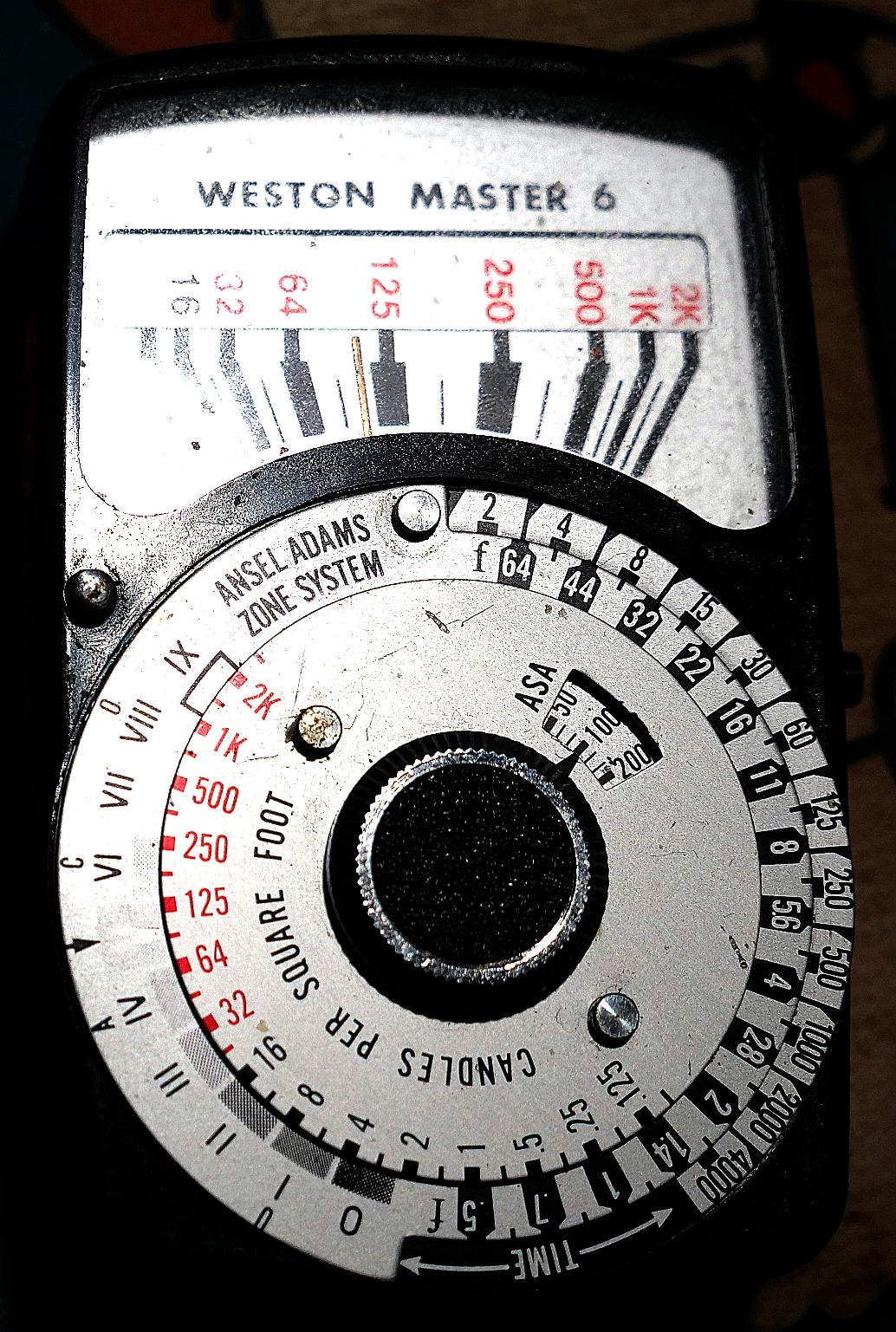
Ansel dial.JPG


Ideas on how to work it are welcome (I am familiar with the said Zone System in principle).

Unfortunately, the meter instructions are missing and, in any case, the dial is an option - the original was in the box ...
 
Last edited:
Hi, Ted,

Wow! Neat-O.

This is probably predicated on reflected light metering.

Best regards,

Doug
Found a manual! The instructions look the same as for your Master V.


No mention of a C constant. It did come with "dome" attachment to fit over the sensor, FWIW.

1) It mentions the Adams dial but not how use it; just refers to Adams' and a Minor White Zone system books elsewhere. Such books would not be specific to the Master6.

The printed-in-Japan instructions only give Weston's USA address for Service and for the Ansel dial option, so that could mean that the Master6 was made in Japan under a Weston license. We still don't know who by for sure.

Although it is said that the Master6 is frowned upon by the cognoscenti, I have bought several Master V's for research - none of which worked (low/dead sensors) - but my 6 gives good enough results... no more than an EV off ...
 
Last edited:

Doug Kerr

Well-known member
Hi, Ted,

The Google AI 'bot has this to say about the Zone system adaptation of the Weston exposure calculator dial:

******
To get accurate zone readings from your vintage light meter, you will need an auxiliary Zone System overlay dial or pre-printed scale (sometimes found via John's Weston Meter Collection). The basic workflow involves aligning your metered value to Zone V (middle gray) on the dial, then rotating the outer calculator dial to place your shadows in Zone II or highlights in Zone VII.
******

I am unable to much of that.

This is cited by the 'bot:


Best regards,

Doug
 

Doug Kerr

Well-known member
I have not given a lot of attention to the Ansel Adams Zone System of exposure.

My thought has always been that its overall objective was really much parallel to our objective with incident light metering: that on the print, the reflectance of each element of the image would correspond to the reflectance of that element of the scene.

So a gray cat on a snowdrift would end up on the print as a gray cat on a white background; a black cat on a coal pile would end up on the print as a black cat on a black background.

Best regards,

Doug
 
Top