• Please use real names.

    Greetings to all who have registered to OPF and those guests taking a look around. Please use real names. Registrations with fictitious names will not be processed. REAL NAMES ONLY will be processed

    Firstname Lastname

    Register

    We are a courteous and supportive community. No need to hide behind an alia. If you have a genuine need for privacy/secrecy then let me know!
  • Welcome to the new site. Here's a thread about the update where you can post your feedback, ask questions or spot those nasty bugs!

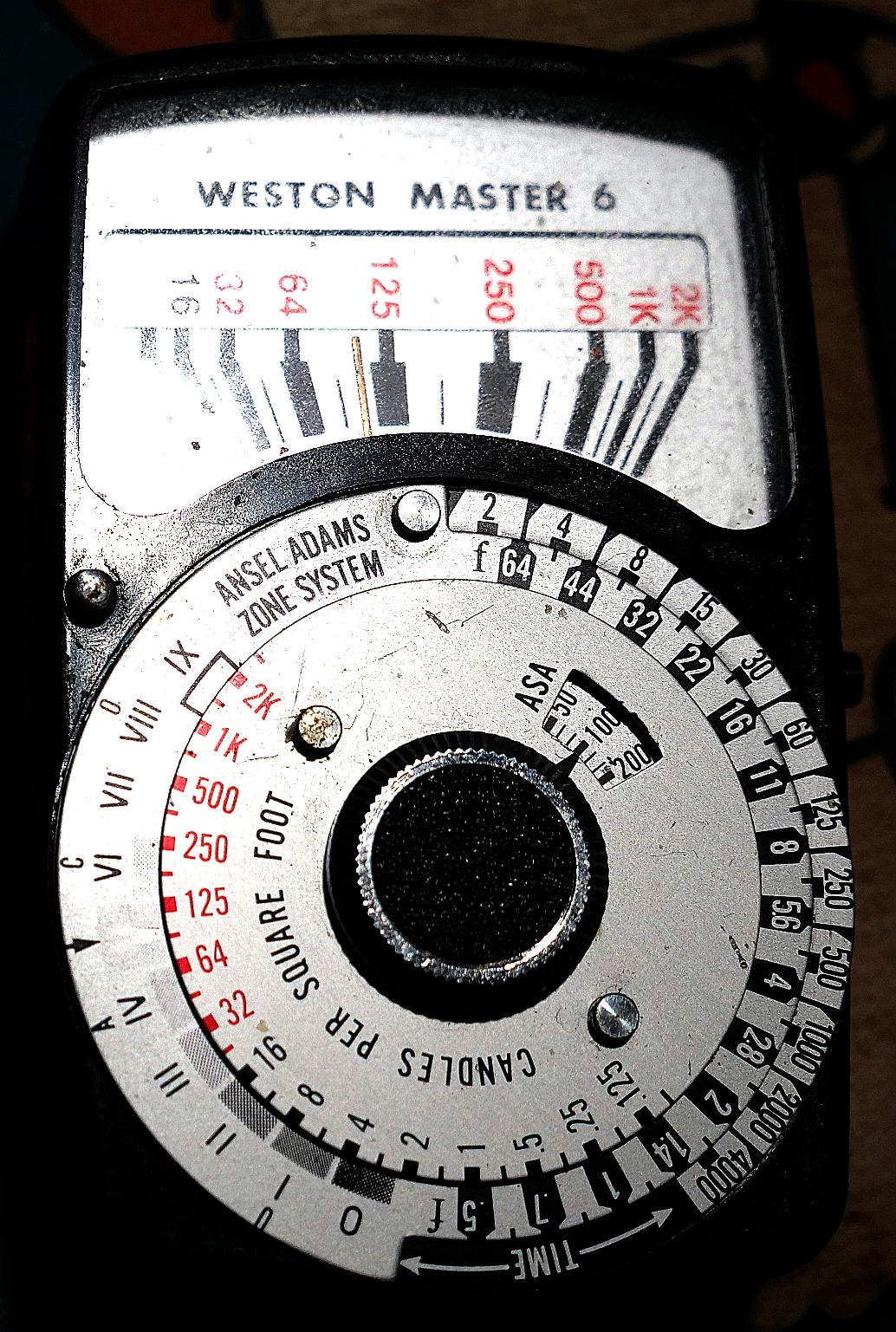
Adams Zone Dial on a Weston 'Master' lightmeter

Found on ebay and immediately snapped up !!

Ansel dial.JPG


Ideas on how to work it are welcome (I am familiar with the said Zone System in principle).

Unfortunately, the meter instructions are missing and, in any case, the dial is an option - the original was in the box ...
 
Last edited:
Hi, Ted,

Wow! Neat-O.

This is probably predicated on reflected light metering.

Best regards,

Doug
Found a manual! The instructions look the same as for your Master V.


No mention of a C constant. It did come with "dome" attachment to fit over the sensor, FWIW.

1) It mentions the Adams dial but not how use it; just refers to Adams' and a Minor White Zone system books elsewhere. Such books would not be specific to the Master6.

The printed-in-Japan instructions only give Weston's USA address for Service and for the Ansel dial option, so that could mean that the Master6 was made in Japan under a Weston license. We still don't know who by for sure.

Although it is said that the Master6 is frowned upon by the cognoscenti, I have bought several Master V's for research - none of which worked (low/dead sensors) - but my 6 gives good enough results... no more than an EV off ...
 
Last edited:

Doug Kerr

Well-known member
Hi, Ted,

The Google AI 'bot has this to say about the Zone system adaptation of the Weston exposure calculator dial:

******
To get accurate zone readings from your vintage light meter, you will need an auxiliary Zone System overlay dial or pre-printed scale (sometimes found via John's Weston Meter Collection). The basic workflow involves aligning your metered value to Zone V (middle gray) on the dial, then rotating the outer calculator dial to place your shadows in Zone II or highlights in Zone VII.
******

I am unable to much of that.

This is cited by the 'bot:


Best regards,

Doug
 

Doug Kerr

Well-known member
I have not given a lot of attention to the Ansel Adams Zone System of exposure.

My thought has always been that its overall objective was really much parallel to our objective with incident light metering: that on the print, the reflectance of each element of the image would correspond to the reflectance of that element of the scene.

So a gray cat on a snowdrift would end up on the print as a gray cat on a white background; a black cat on a coal pile would end up on the print as a black cat on a black background.

Best regards,

Doug
 

Doug Kerr

Well-known member
It is interesting to consider some of the phtometric units we encounter in the area of phtographic esposure metering.. The matter is complicated by similar-sounding but different terms, what seem to be compound unit names but are not, and of course various careless practices.

I will disucss here some of these units often encountered in connection with exposure metering.

We might expect that, in the evolution of these chains of terms, we would start with the measure of luminous flux. But in reality, the chains of definitions begin with the meaure of luminous intensity - the "potency" of the emission of light from a small source (ikeally, a "poiont source) in some direction of interest.

Long before the advent of the SI, this was done in terms of the luminous intensity (in a certain defined direction) of a "standard candle", an actual candle in which a precisely-defined type of wax was burned at a specified rate. The unit of luminous intensity thus became the candlepower.

The SI unit of luminous intensity is the candela. But this is sometimes carelessley called the "candleopwer".

Luminance can be thought of as the "brightness" of a surface. It is the amount of luminous intensity per unit of area.

The SI unit of luminance is the candela per square meter.

Two non SI (but SI-related) units of illuminance are the lambert and the foot-lambert. "Foot-lambert" is not the product of the foot and the lambert, as it might seem from the name, but rather "foot" is to tell us that this is defined in tems of the luminous intensity per square foot, whereas in the lambert it is per square meter. These are defined in terms of the SI unit for luminous intensity, the candela.

But a wholly pre-SI unit for luminance is the candle per square foot, where "candle" alludes to the "standard candle".

More later.

Best regards,

Doug

 
Last edited:
Hi, Ted,

The Google AI 'bot has this to say about the Zone system adaptation of the Weston exposure calculator dial:

******
To get accurate zone readings from your vintage light meter, you will need an auxiliary Zone System overlay dial or pre-printed scale (sometimes found via John's Weston Meter Collection). The basic workflow involves aligning your metered value to Zone V (middle gray) on the dial, then rotating the outer calculator dial to place your shadows in Zone II or highlights in Zone VII.
******

I am unable to make much of that.
Here's one similar to mine:

adams-dial dl.jpg


Here we see that someone has set the V mark close to 250 fc. If the scene had been your snow plus black cat, we know that if we select any of those recommended settings, e.g. f/8 at 1/125 sec. we would get gray snow and a seriously black cat. We all know how to fix that on normal cameras with EC but here we are talking Zone-speak - so, in this case, how to "place" the snow in the correct Zone, say VII?

I say rotate the VII mark to line it up with metered value of 250 fc. The recommended exposure will obligingly increase by two stops causing snow to be rendered as white and the black cat might gain some detail. For more white, put "VIII" in line with the metered value ... etc.

In your coal-pile situation,we would place "II" against the metered value so as to properly expose the would-be blown white cat.

Make sense?

I notice, at least on mine, one no longer relies on a unique position of a big arrow to determine a good exposure.
 
Last edited:

Doug Kerr

Well-known member
Hi, Ted,
Here we see that someone has set the V mark close to 250 fc. If the scene had been your snow plus black cat, we know that if we select any of those recommended settings, e.g. f/8 at 1/125 sec. we would get gray snow and a seriously black cat. We all know how to fix that on normal cameras with EC but here we are talking Zone-speak - so, in this case, how to "place" the snow in the correct Zone, say VII?

I say rotate the VII mark to line it up with metered value of 250 fc. The recommended exposure will obligingly increase by two stops causing snow to be rendered as white and the black cat might gain some detail. For more white, put "VIII" in line with the metered value ... etc.

In your coal-pile situation,we would place "II" against the metered value so as to properly expose the would-be blown white cat.

Make sense?
Yeah, I think so.

Thanks for that nice explanation.

Best regards,

Doug
 

Doug Kerr

Well-known member
Hi, Ted,

That concept seems to well fit this scenario:

We meter on a reflected light basis some important feature of the scene (perhaps with a meter having a "spot metering" capability). We decide which Adams "zone" that feature should be assigned based on our estimate of the reflectance of that feature (imagined on the "Adams zone scale", not as a numerical reflectance).

We then use the corresponding zone arrow on the exposure meter exposure calculator. The result should be that this feature would be properly exposed based on its presumed reflectance, and scene features of other reflectances will follow suit.

My problem is that the Weston Ranger 9 (to pick on the model for which the Zone System auxiliary calculator dial was seemingly first made available) has a field of view (so far as I can determine) about 18° in diameter. This seems to hardly suit it, for the typical scene, to make a luminance measurement of a "particular feature" of the scene.

Maybe.

Best regards,

Doug
 

Doug Kerr

Well-known member
Hi, Ted,

I have seen it said that Ansel Adams "poo-pooed" the use of incident light measurement as a more direct alternative to the practice he suggested.

After pondering his explanation (which is not too clear), I conclude as follows:

• In incident light metering, we seek to have the exposure of each scene element proportional to its absolute reflectance.

• In Zone System exposure determination, we seek to have the exposure of each scene element proportional to its relative reflectance.

But there may be more to it than that.

Best regards,

Doug
 
Last edited:

Doug Kerr

Well-known member
Adams says that the shortcoming of the incident light metering technique is that the meter is unaware of the luminance of the scene elements.

That is true. But what we do know is, if we learn via the meter the illuminance upon the scene, for a scene element of any given reflectance what will be its luminance (at least in an "ideal" situation).

Best regards,

Doug
 
Hi, Ted,

That concept seems to well fit this scenario:

We meter on a reflected light basis some important feature of the scene (perhaps with a meter having a "spot metering" capability). We decide which Adams "zone" that feature should be assigned based on our estimate of the reflectance of that feature (imagined on the "Adams zone scale", not as a numerical reflectance).

We then use the corresponding zone arrow on the exposure meter exposure calculator. The result should be that this feature would be properly exposed based on its presumed reflectance, and scene features of other reflectances will follow suit.

My problem is that the Weston Ranger 9 (to pick on the model for which the Zone System auxiliary calculator dial was seemingly first made available) has a field of view (so far as I can determine) about 18° in diameter. This seems to hardly suit it, for the typical scene, to make a luminance measurement of a "particular feature" of the scene.

Maybe.

Best regards,

Doug

Google AI tells us that the Weston Master 6 has even more field of view than your Ranger 9 ...

Google said:
The Weston Master 6 light meter features a reflected light field of view (or angle of view) of approximately 30° to 45°. This acceptance angle roughly mimics that of a "normal" camera lens, allowing it to take generalized readings of a scene without capturing too much peripheral light or skylight.

In any case, didn't Adams use a spot-meter?

In other words, we wouldn't try to meter "features" with our Weston's. In the cash of snow or coal-heaps, or ash for that matter, I envisioned them filling the frame ...

best,

Ted.
 
Last edited:

Doug Kerr

Well-known member
Top