
• Please use real names.

    Greetings to all who have registered to OPF and those guests taking a look around. Please use real names. Registrations with fictitious names will not be processed. REAL NAMES ONLY will be processed

    Firstname Lastname

    Register

    We are a courteous and supportive community. No need to hide behind an alia. If you have a genuine need for privacy/secrecy then let me know!
  • Welcome to the new site. Here's a thread about the update where you can post your feedback, ask questions or spot those nasty bugs!

Battery-less Sekonic hand-held light-meter versus commercial (non-photographic) ...

Most battery-less photographic light-meters loose sensitivity over time as the sensor ages, especially Weston 'Master' Models up to model V.

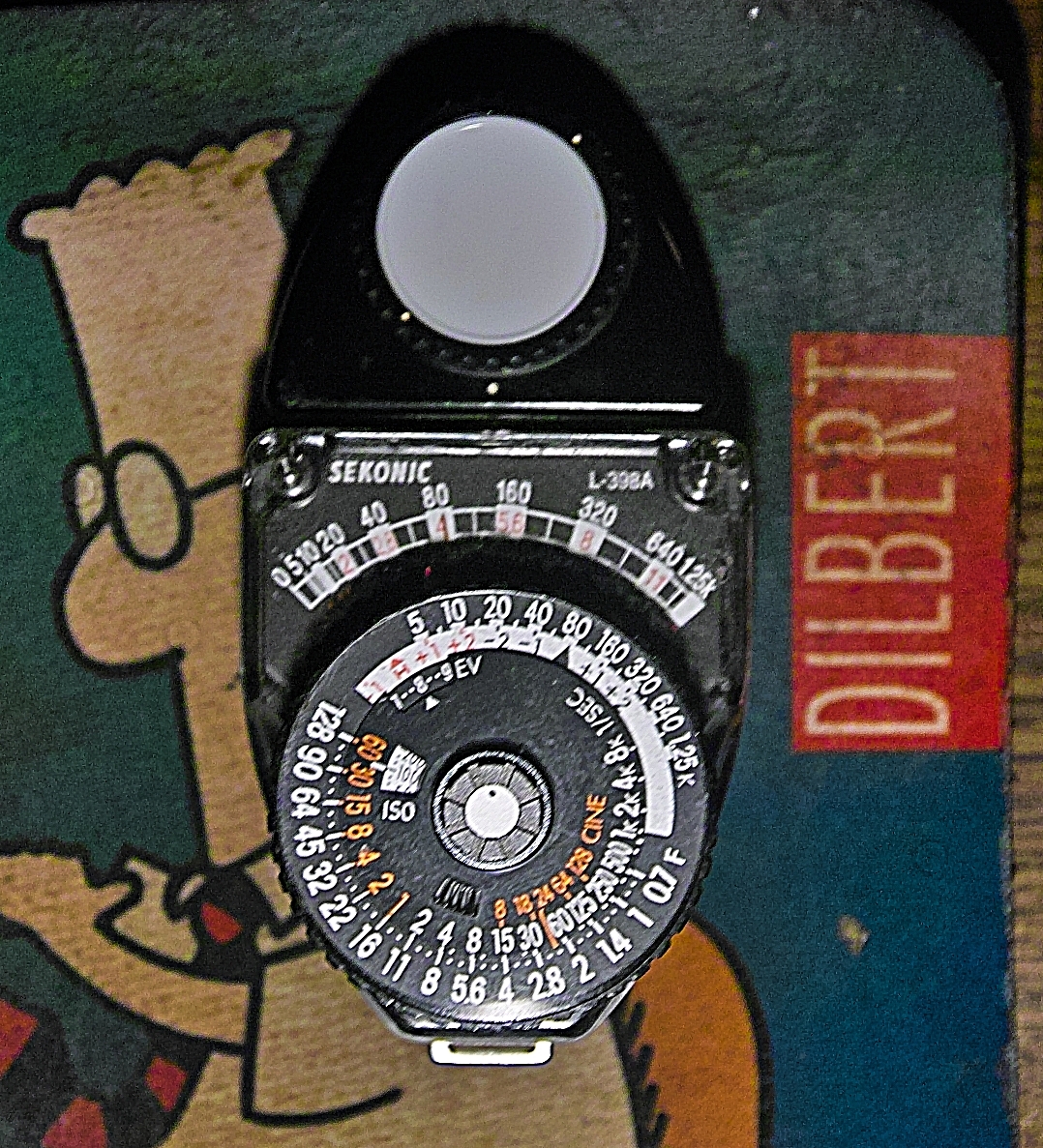
A couple weeks ago, I found a Sekonic Model L-398A cheap on ebay and bought it because it still current and has an amorphous silicon sensor - much less susceptible aging than Selenium.

Pardon the pic quality:
l-398A- 100 ISO.jpg


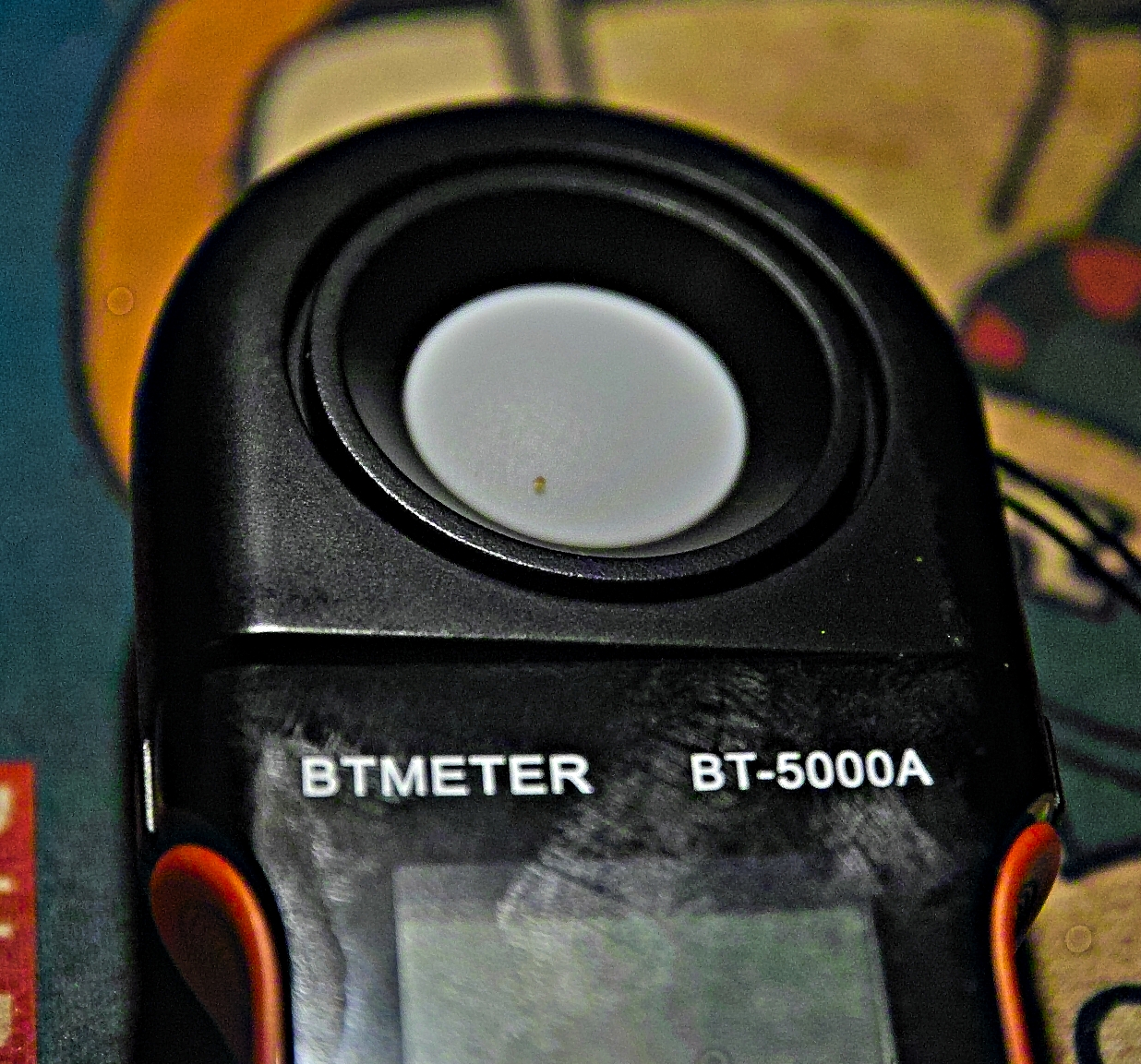
I already owned a 4% accurate commercial light-meter ...
BTMETER.jpg


It has a sunken semi-dome filter ... I'm guessing for cosine response ...

About 14" from a cool white office desk lamp, the Sekonic 398A tells me 80 foot-candles (fc), 8Ev. The BTMETER tells me 39 fc.

Assuming that the l-398A hasn't been dropped, is the reading reasonable, I wonder?

Others:
My good-ish Japanese-made Weston Master6 tells me 26 fc. My original Sekonic 398 at 100 ASA with the dome on tells me about 65 fc, might be75 fc with the flat disk, couldn't be bothered to mount it.
 

Doug Kerr

Well-known member
Ted,

[The L-398A is my favorite photographic exposure meter.]

When you did the comparison using the L-398A, did you have the flat receptor on? This is the one prescribed for making incident illuminance measurements (not in the photographic context).

I note that we might expect the flat receptor to give nearly a cosine response, which is what is appropriate for illuminance measurement. The dome receptor used for photographic exposure metering purposes is often erroneously thought to give a cosine response, but in fact it gives roughly a "Norwood" response. The story behind that is fairly complicated, but I discuss it at length in an article on The Pumpkin. Here is a link to its listing:


However, there are often considerable discrepancies between the readings these meters give in the "illuminance" mode and what wholly non-phtographic meters (as typically used in illumination engineering and such) will show.

I never found our the reason for that.

The problem is discussed in Append1x B of my article, "The 'Norwood Director' family of photographic exposure meters". Here is a link to its listing on the index page of The Pumpkin:


Best regards,

Doug
 

Doug Kerr

Well-known member
Ted,

Measurement of illuminance

Keep in mind that the physical property illuminance describes the impact of light upon a surface of some certain orientation with respect to the direction of arrival of the light.

If we assume a small light course (perhaps a bulb at a considerable distance), then at some certain point away from the source the luminous flux density of the light "beam" will have some value. That is a property of the arriving light beam at that point, and does no presume anything for the light to land on. But the illuminance at that point must be considered as upon a surface of some certain orientation.

As a special case, if we imagine a surface to which the direction of arrival of the light is perpendicular, then the illuminance on that surface is numerically the same as the luminous flux density of the "beam" at that point.

But if the direction of arrival of the light beam is not perpendicular to the surface of interest (real or hypothetical), then the illuminance is the luminous flux density at that place times the cosine of the angle the direction of arrival of the light beam makes with the perpendicular to the surface.

Now if we have, falling on some surface, light coming from two different directions, the total luminance is the sum of the illuminance that each "beam" would create, taking into account for each the angle bwteen its direction of arrivaal and the perpendicularmto the ruafce.

That is why a meter to measure illuminance ideally has a "cosine" angular repose: so it will in effect make that reckoning as it goes.

But we must orient the meter so that its flat receptor (if that is what is has) is at the same orientation as that of the surface (real or hypothetical) of interest.

******

Norwood's dome - the short story

Phtographers early learned tbat when a subject (perhaps a film actor's head) received light from several directions, the choice of a desirable phtographic exposure was not obvious. Eventually, often empirical metering technaues were used that mesaured the light from differnt directions and combined those readings with some formula to lead to the "desirable exposure". Thisn was of course very tedious.

Don Norwood discovered that in many of the lighting situaions encountered in professional cinema work, an exposure meter would give a "desirable" exposure recommendation (that is what exposure meters do) with a single measurement if is was equipped with a hemispherical receptor.

Pressed by his technical colleagues to explain the theoretical basic for this, Norwood concocted a story that fails scrutiny in many ways. But the reality was nevertheless that, emporically, this type of meter was found to in many cases give a phtographic expsure recommendation that gave an exposre resuit considered to be "good" (and this is of course a subjective assessment).

A result is that very many photographic exposure meters, in their normal "phtographic exposure" mode, use a hemispherical receptor.

******

Best regards,

Doug
 

Doug Kerr

Well-known member
I note that much writing, luminous flux density and illuminance are considered to be the same thing, and are often indicated by the same symbol.

They are not the same thing. At a certain point distant from some light source of small angular size (as seen from that place):

Luminous flux density is a measure of the "potency" of the beam of light itself at that place.

Illuminance is a measure of the "impact" of that beam on a surface (real or hypothetical) at that place at some specific orientation with respect to the direction of arrival of the light beam.

Further confusion comes from the fact that the recommended symbol used for both those quantities is Ev (that "v" is a subscript, but I don't know how to do that on this text entry screen). "V" indicates "visible", and is meant to distinguish this photometric quantity, which is defined in terms of human visual response, from the parallel radiometric property, irradiance, which however is defined in purely physical terms (and for which the symbol is E).

It is easy to confuse this with the wholly unrelated symbol, Ev, from the APEX system, which describes in a logarithmic way a photographic exposure (combination of exposure time and aperture)

Adding to this mess is the fact that the luminance of a photographic subject (as for example determined by reflected light exposure metering) is often improperly given as a value of the APEX quantity Ev. (The notion behind that I will not trouble you with here.)

Best regards,

Doug
 
Thank you Doug, I was indeed hoping for a response from your good self. Thanks for the links ... I have been to the Pumpkin many, many times, especially to your various papers on metering.

Earlier you said

However, there are often considerable discrepancies between the readings these meters give in the "illuminance" mode and what wholly non-phtographic meters (as typically used in illumination engineering and such) will show.

I never found out the reason for that.

Yes, that's what I'm scratching my head about ... pity that ...

In my quick and dirty test, the lamp bulb axis was or less aligned normal to the Lumidisk/BTMETER dome top.

On the BTMETER, the top of the dome is about 1/8" below the cap mounting ring - hard to see here.


Doug Kerr

Well-known member
i am always worried by product descriptions or essays that start with the wrong names being used for important things.

The squib for the BITMETER Light Lux Meter 5000A says that it "can test for light illuminance up to 400,000 lux".

Of course the lux is the unit of luminance, not illuminance. Luminance is what we can think of as the "brightness" of some illuminated or self-luminous object. It is what reflected light photographic exposure meters work from. (Exposure meters such as the Sekonic L-398A are incident light meters, work work from the illuminance caused by the light source(s) on the photographic subject.

It is easy to use the wrong one of the terms luminance and illuminance since they are so similar. I do it myself all the time.

I will look further into the information on the BITMETER instrument. More after that.

Best regards,

Doug
 

Doug Kerr

Well-known member
Hi, Ted,

The bottom line seems to be that one cannot use any of the Sekonic photographic exposure meters of the general style of which the Model L-398A is the most recent to measure illuminance (in the sense that we might want to know from an "illuminating engineering" standpoint).

This is notwithstanding the explicit information in the instructions for these instruments and the inclusion of a flat receptor for use specifically for that purpose.

This of course is very odd to me, given the overall attention to detail of all those instruments.

This discrepancy was first brought to my attention by John D. De Vries, noted collector of ans expert on exposure meters.

Best regards,

Doug
 

Doug Kerr

Well-known member
Hi, Ted,

It is interesting n that Sekonic made an actual luminance meter in a form very similar to their photographic exposure meters of the family we have been discussing. This was the Model 248 Illuminometer. We see it here:

1777818528789.png

Note that, unlike the similar-looking photographic exposure meters, this has no calculator dial. A big decorative "medallion" fills the space where that would go on the photographic exposure meters in that family.

My work with my specimen of this instrument suggest that its readings of illuminance are "credible". But this was based on comparison with an actual illuminance meter (but not one with certified accuracy).

Best regards,

Doug
 

Doug Kerr

Well-known member
Hi, Ted,

My apologies.

In fact illuminance is denominated (in the SI system) in lux. That is not the unit for luminance, as I had suggested earlier.

As I said, it is easy to get confused about these things (especially before I have had breakfast).

Sorry for the misdirection.

Best regards,

Doug
 
Top